
Every morning, while thousands of children in Bangladesh put on their school uniforms and rush toward classrooms, there is another group of children walking in the opposite direction.
Not toward education.
Not toward safety.
Not toward childhood.
But toward survival.
One of them is Rahim.
Rahim is around nine years old. Nobody knows his exact age because he has never celebrated a birthday. He lives in a small roadside settlement beside a busy area in Dhaka with his mother and younger sister. Their home is made from old bamboo, torn plastic sheets, and rusted tin. During heavy rain, water leaks through the roof. During winter nights, cold air enters through every corner.
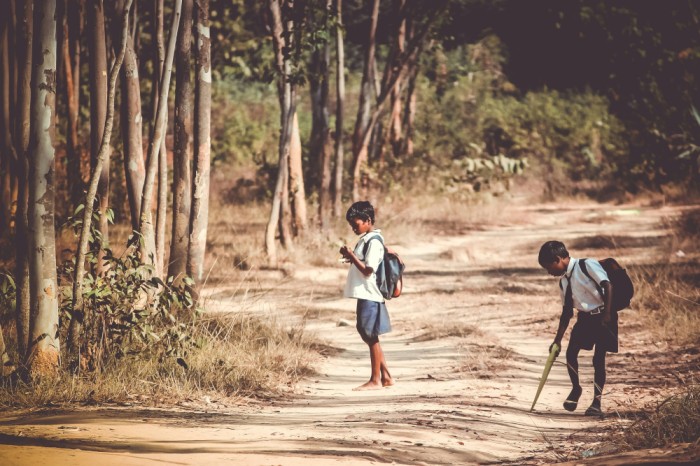
Every day before sunrise, Rahim wakes up not because of an alarm clock, but because hunger does not let him sleep peacefully.
While most children hold books, Rahim carries a dirty sack on his shoulder. He walks through streets, markets, and garbage piles collecting plastic bottles, cans, and scraps to sell. Sometimes he earns enough to buy rice for the family. Sometimes he does not.
One afternoon, during a field visit, a volunteer from a social welfare organization noticed Rahim sitting quietly beside a drain. He was not playing like other children nearby. He was simply watching a group of students crossing the road wearing clean school uniforms and carrying colorful backpacks.
The volunteer sat beside him and asked softly:
“Do you want to go to school?”
Rahim remained silent for a few seconds.
Then he looked down and replied:
“I do… but school costs money.”
The volunteer asked another question:
“If you could have one thing in life right now, what would you ask for?”
The answer was heartbreaking in its simplicity.
“A school bag.”
Not a smartphone.
Not expensive clothes.
Not toys.
Not luxury.
Just a school bag.
That moment became a painful reminder of how differently life treats people born into poverty.
For many of us, education is expected. It is normal. We complain about exams, assignments, and morning classes. But for millions of children across Bangladesh, education is still a distant dream.
Some children leave school because their parents cannot afford books.
Some work in tea stalls, factories, or workshops before they even learn how to properly read and write.
Some girls are forced into early marriage because their families see no other option.
Some children simply disappear into the cycle of poverty before society even notices they existed.
Yet behind every struggling child is a dream waiting for one opportunity.
Rahim’s dream was small. He wanted to study. He wanted to wear a uniform. He wanted to become “someone important” so his mother would never need to cry about money again.
When asked what he wanted to become in the future, Rahim answered proudly:
“A teacher.”
Why?
“Because teachers help children learn.”
That answer carried more wisdom than many adults possess.
A child who barely had enough food still dreamed of helping others.
This is the hidden beauty often found among underprivileged communities. Even in suffering, humanity survives. Even in darkness, hope still breathes quietly.
After learning about Rahim’s condition, volunteers arranged educational support for him. He received books, basic clothing, and eventually admission into a local school. The first day he received his school bag, he held it tightly against his chest as if it were treasure.
For many people, it was only a simple bag.
For Rahim, it was dignity.
It was hope.
It was the beginning of a different future.
But the truth is, there are thousands more children exactly like Rahim.
Children standing at traffic signals selling flowers instead of learning mathematics.
Children washing dishes in restaurants instead of writing essays.
Children carrying bricks instead of carrying dreams.
And perhaps the most painful part is this:
Many of them do not need massive wealth to change their lives.
Sometimes all they need is:
- One sponsor
- One caring human
- One chance
- One organization willing to stand beside them
Social welfare is not only about donating money.
It is about restoring humanity where society has forgotten it.
It is about seeing people not as statistics, but as human beings.
It is about understanding that behind every poor face is a story nobody hears.
A mother skipping meals so her children can eat.
A father working through illness because stopping means starvation.
A child pretending not to be hungry because there is no food left at home.
These stories exist all around us.
Sometimes only a few streets away from our comfortable lives.
The real question is not whether poverty exists.
The real question is whether we are willing to care.
In today’s world, people often believe they are too small to create change. They think helping others requires enormous resources or powerful influence.
But real impact often begins with very small actions.
Buying books for one child.
Providing winter clothes for one family.
Helping someone receive medical treatment.
Supporting education for a student.
Volunteering a few hours.
Speaking kindly to people society ignores.
Humanity grows through small acts repeated consistently.
History rarely remembers those who only lived for themselves.
But society never forgets people who brought light into dark places.
Organizations working for social welfare are not simply distributing food or supplies. They are rebuilding hope inside communities that have been abandoned for generations.
And perhaps hope is one of the most powerful things a human can receive.
Because once a child begins to believe life can improve, everything changes.
That child studies harder.
Dreams bigger.
Lives differently.
And one day, may even become the person who helps others rise too.
Today, Rahim still studies in school.
Life is not perfect for him.
His family still struggles financially.
But now he walks with books in his hands instead of garbage bags.
And every morning, when he wears his school uniform, his mother smiles quietly because she sees a future she once thought was impossible.
Somewhere tonight, another child like Rahim is sleeping hungry.
Another mother is crying silently.
Another father is wondering how to survive tomorrow.
And another dream is waiting for someone to notice it.
Maybe humanity changes when we stop asking,
“Why should I help?”
And start asking,
“If not me, then who?”
Because sometimes, changing the world begins with something as small as giving a child a school bag.
References & Inspiration
This story is inspired by the real struggles of underprivileged children in Bangladesh and reflects issues commonly documented by humanitarian organizations, education-focused NGOs, and social welfare volunteers working in urban slums and rural communities.
Key social issues reflected in this story include:
- Child labor
- Educational inequality
- Poverty and food insecurity
- Slum living conditions
- Access to education for disadvantaged children
- Social welfare and community support
The character “Rahim” is fictional, but the experiences portrayed are based on realities faced by many children across Bangladesh.
Inspired by field observations, volunteer experiences, and humanitarian work conducted by organizations supporting:
- Child education
- Poverty alleviation
- Community welfare
- Youth empowerment
- Emergency humanitarian assistance
“Every child deserves dignity, education, and hope.”
-Ujjibito Foundation